Grams to Cups: Why 1 Cup Isn't Always the Same Weight
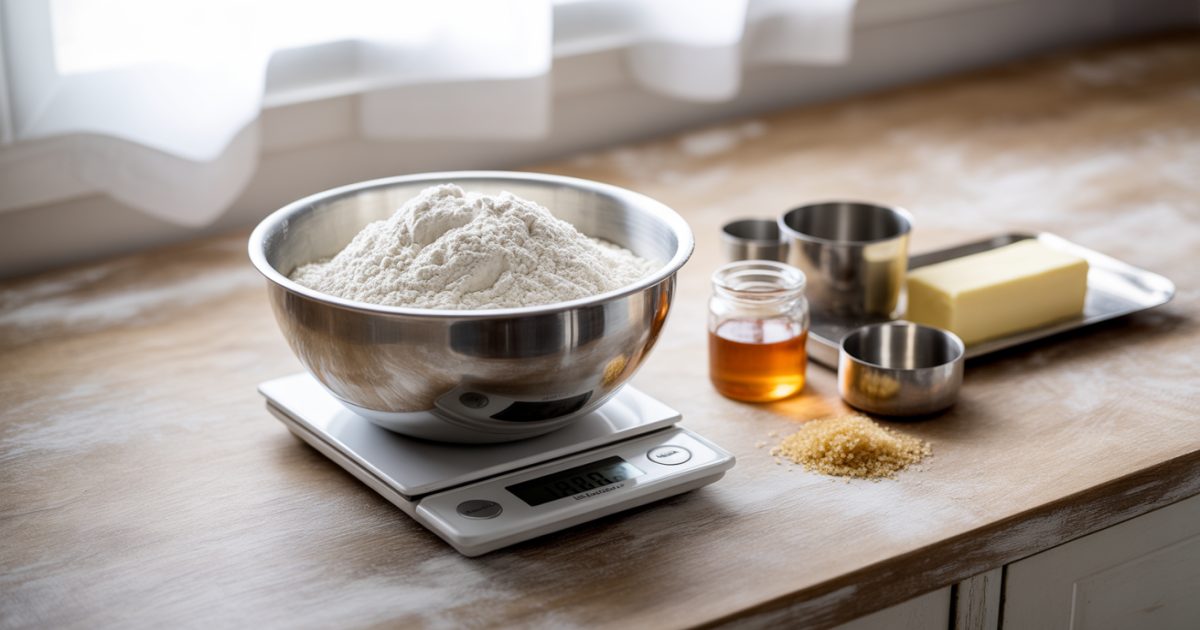
A cup measures volume, not weight. The US cup is a fixed 236.6 mL of space, but grams measure how heavy the stuff filling that space is. Since every ingredient has its own density, one cup lands on a different gram figure each time: about 240 g of water, 125 g of flour, 200 g of sugar, 340 g of honey.
Why isn't one cup always the same weight?
Because a cup measures volume and grams measure weight, and the bridge between them is density. A cup fixes the amount of space you fill, roughly 236.6 mL. How much that space weighs depends on how tightly packed the ingredient's mass is. Honey is dense, flour is fluffy, so the same cup can hold anywhere from 85 g of cocoa to 340 g of honey.
Think of it the way you'd think about a moving box. A box full of feathers and a box full of books take up the same room, but the scale tells a completely different story. Flour is the feathers of the kitchen. Honey is the books. The cup is the box, and it never changes size.
How many grams is one cup of common ingredients?
It depends entirely on the ingredient. A cup of water weighs about 240 g, flour about 125 g, granulated sugar about 200 g, brown sugar about 220 g packed, butter 227 g, and honey around 340 g. The table below gives the working figures most American recipes use for a standard US cup.
| Ingredient (1 US cup) | Weight in grams | Why it lands there |
|---|---|---|
| Water | ~240 g | Reference density, about 1 g/mL |
| Milk | ~240 g | Density close to water |
| All-purpose flour | ~125 g | Light and airy, lots of gaps |
| Granulated sugar | ~200 g | Dense crystals, packs tight |
| Brown sugar (packed) | ~220 g | Moist, pressed into the cup |
| Powdered sugar | ~120 g | Fine and fluffy, spooned in |
| Butter | ~227 g | Solid fat, equals 2 sticks |
| Honey | ~340 g | Heaviest here, very dense |
| Cocoa powder | ~85 g | Extremely light, full of air |
| Rolled oats | ~90 g | Big flakes, plenty of air gaps |
| Uncooked white rice | ~185 g | Hard grains, settle densely |
Why is honey so much heavier than flour in the same cup?
Honey weighs nearly three times as much as flour per cup because it's far denser. Honey has almost no air in it and sits around 1.4 g/mL, so a cup packs in about 340 g. Flour is mostly air between fine particles, near 0.53 g/mL, so the same cup holds only about 125 g. The volume is identical; the mass inside it is not.
This is the whole reason a recipe can't just say "one cup equals so many grams" and be done. A cup of feathers and a cup of lead are both a cup. What changes is what you're measuring, and grams are honest about that in a way cups never can be.
Why is baking by weight more accurate than cups?
Weighing removes the guesswork that volume invites. How you scoop, pack, sift, or settle an ingredient can swing a cup of flour by 15 to 25 percent. A gram, on the other hand, is a gram no matter how you got it into the bowl. That's why professional bakers weigh everything and why precise recipes now list grams first.
Here's how to switch a cup-based recipe over to the scale without redoing the whole thing.
- Set the scale to grams — put your empty mixing bowl on it and press tare to zero out the bowl's weight.
- Look up each ingredient's grams-per-cup — use the table above; don't assume they share a number.
- Multiply by the recipe amount — two cups of flour at 125 g each is 250 g. Add each ingredient by weight, taring between them.
- Trust the scale over the cup — if the numbers disagree, the weight is the accurate one. Cups drift; grams don't.
Does the cup size change the answer too?
Yes, and it catches people cooking from international recipes. A US customary cup is 236.6 mL, but a metric cup is 250 mL and an old imperial cup is 284 mL. Use a 250 mL cup for a recipe written in US cups and every ingredient comes out about 6 percent heavy, which compounds across a batch.
Nutrition labels add one more wrinkle: the US "legal" cup used for serving sizes is 240 mL, slightly larger than the customary 236.6 mL cup your measuring set is based on. The gap is small, but it's why you'll see a cup of water quoted as both 236 g and 240 g depending on the source. For baking, 240 g is the number worth remembering.
Frequently asked questions
How many grams is one cup of flour?
About 125 g for all-purpose flour spooned and leveled, though King Arthur Baking uses 120 g. Scoop straight from the bag and you'll get 145 g or more, because scooping compacts the flour. That variance is exactly why weighing beats measuring for flour.
Is a cup of water 240 grams or 236 grams?
Both are correct depending on which cup you mean. The US customary measuring cup is 236.6 mL, so pure math gives about 237 g of water. Baking references round to 240 g to match the 240 mL "legal" cup on nutrition labels. For recipes, use 240 g.
Why does honey weigh more than water per cup?
Honey is denser than water, around 1.4 grams per milliliter versus water's 1.0. A cup of honey holds the same volume as a cup of water but packs in about 340 g compared to water's 240 g. Density, not volume, drives the difference.
Can I use one grams-per-cup number for everything?
No. That only works if every ingredient had the same density, and they don't. Flour, sugar, cocoa, and honey all weigh different amounts in the same cup. You need a per-ingredient figure, which is why conversion charts list each one separately.
Does packing brown sugar really change the weight?
Quite a bit. Brown sugar is measured packed, pressed firmly into the cup, which brings it to about 220 g. Spooned in loosely, the same cup might hold only 145 g. Almost every recipe assumes packed, so press it down unless told otherwise.
Do I need a scale, or are cups good enough?
Cups are fine for forgiving cooking like soups and stews. For baking, where the ratio of flour to liquid decides the outcome, a scale pays off fast. An inexpensive digital kitchen scale eliminates the scooping and packing variance that ruins cakes and bread.
How many grams of butter are in a cup?
227 g, which is 2 standard American sticks or half a pound. Butter is one of the few ingredients where the cup measurement is reliable, since sticks are pre-portioned and wrappers are marked in tablespoons.
Once you see that a cup is just a box of fixed size, the grams stop being mysterious: every ingredient fills that box at its own weight. When you need the exact number for whatever you're baking, run it through the Cups from Grams Calculator, which converts any ingredient by cup and grams so you don't have to memorize the whole chart.