Roof Pitch Explained: Ratios, Degrees, and Slope
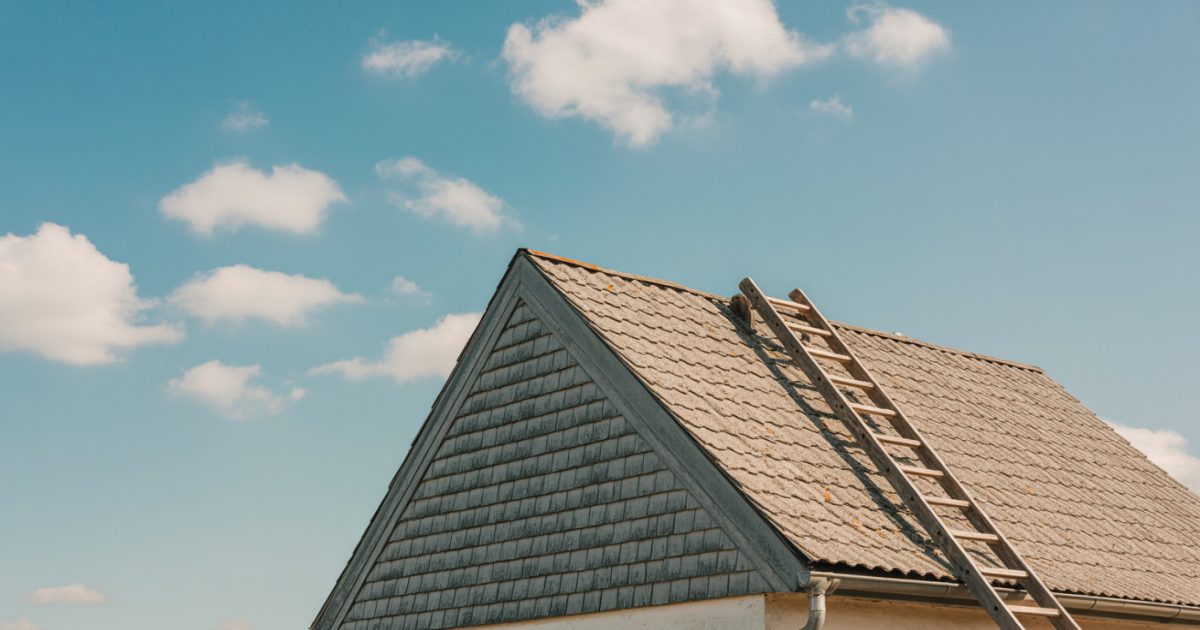
Roof pitch is how steep a roof is, written as inches of rise for every 12 inches of run — so "6:12" means the roof climbs 6 inches vertically for each foot it travels horizontally. Turn that ratio into an angle with arctan(rise ÷ 12): a 6:12 works out to about 26.57 degrees. That single number decides what materials you can use, whether you can walk the roof, and how much surface you are actually covering.
What does a roof pitch like 6:12 actually mean?
The two numbers are rise and run. Rise is how far the roof goes up; run is how far it goes across, and by convention the run is always fixed at 12 inches. So 6:12 reads as "6 up for every 12 across." Only the first number changes. A 4:12 is gentle, a 12:12 climbs at a full 45 degrees, and the notation stays constant because the 12 never moves.
How do you convert roof pitch to degrees?
Take the rise, divide by the run of 12, then apply the inverse tangent: angle = arctan(rise ÷ 12). For a 6:12 that is arctan(0.5) = 26.57 degrees. On any calculator with a tan⁻¹ or atan key, punch in the rise divided by 12 and hit inverse tangent. The result is the roof angle measured from horizontal.
| Pitch | Angle (degrees) | Percent slope | Slope factor | Category |
|---|---|---|---|---|
| 2:12 | 9.46° | 17% | 1.014 | Low slope |
| 3:12 | 14.04° | 25% | 1.031 | Low / walkable line |
| 4:12 | 18.43° | 33% | 1.054 | Conventional |
| 6:12 | 26.57° | 50% | 1.118 | Conventional |
| 8:12 | 33.69° | 67% | 1.202 | Conventional |
| 9:12 | 36.87° | 75% | 1.250 | Steep line |
| 10:12 | 39.81° | 83% | 1.302 | Steep |
| 12:12 | 45.00° | 100% | 1.414 | Steep |
Notice that 12:12 is 45 degrees and 100% slope, not vertical. Percent slope reaching 100% just means rise equals run. And the slope factor in the last column is the number that quietly runs up your material bill, which is worth understanding before you buy anything.
What is the pitch multiplier, and why does it matter?
The pitch multiplier, or slope factor, converts the flat footprint of your house into the real sloped area of the roof. The formula is √(rise² + 12²) ÷ 12. A roof is a slanted plane, so it always covers more surface than the rectangle it sits over. Multiply your footprint by the factor and you get the actual area you have to shingle.
The gap grows fast as the roof steepens. At 4:12 you are covering only about 5% more than the footprint; at 8:12 it is 20% more; at 12:12 the roof is √2, roughly 41%, larger than the ground it shades. Ignore the multiplier and you underbuy on every steep roof, which means a second trip to the supplier partway through the job.
What counts as low slope, walkable, or steep?
Roofers sort pitches into three practical bands. Low slope is under about 3:12, where standard shingles can no longer shed water reliably. Conventional or walkable runs from roughly 3:12 to 9:12, covering most homes. Steep is over 9:12, where you generally need fall protection and the work slows down. The bands come from how water, feet, and safety gear behave on a slope.
Why the cutoffs land where they do: below roughly 2:12 to 3:12, water moves so slowly across overlapping shingles that it can wick backward under them, especially in wind-driven rain, so those roofs use continuous membranes like TPO, EPDM, or modified bitumen instead. Even those need a minimum of about ¼ inch of fall per foot to drain. On the safety side, most people can walk a 6:12 with care, start feeling nervous around 7:12, and by 9:12 a harness and roof jacks become standard rather than optional.
How does pitch affect materials and cost?
Pitch decides three things at once: which materials are allowed, how much surface you cover, and how hard the roof is to work on. A flat-ish roof rules out shingles and pushes you toward membranes. A steep roof adds surface area through the multiplier and adds labor because crews move slower and need fall protection. All three pile onto the final number.
How do you measure your own roof pitch?
You need a level (a 12-inch one is ideal) and a tape measure. The idea is to find the rise at exactly the 12-inch mark of a horizontal run. You can do this on the roof surface, against a rafter in the attic, or on the underside of an eave. Take the reading, and rise-over-12 is your pitch.
- Set the level horizontal — rest one end where it touches the roof or rafter and bring the bubble to center so the level is truly flat.
- Mark 12 inches out — measure along the level from the point where it meets the roof surface and note the 12-inch mark.
- Measure straight down — from that 12-inch mark, measure the vertical distance down to the roof. That reading in inches is your rise.
- Read the pitch — a 6-inch drop at the 12-inch mark is a 6:12. The vertical number over 12 is the whole answer.
- Convert if needed — for an angle, take arctan(rise ÷ 12); for a percent, divide rise by 12 and multiply by 100.
A speed square with a printed pitch scale does the same job in one motion, and a phone level app laid flat on the roof plane will read the angle directly if you would rather skip the arithmetic. Whichever tool you use, take the reading in a spot away from the ridge and eaves, where the plane is cleanest.
Frequently asked questions
What is a 6:12 roof pitch in degrees?
A 6:12 pitch is 26.57 degrees. You get it from arctan(6 ÷ 12) = arctan(0.5). It is also a 50% slope, since 6 divided by 12 is one half. This is one of the most common residential pitches.
Is roof pitch the same as slope?
In everyday US roofing they are used interchangeably in the x:12 form. Strictly speaking, slope is rise over run and pitch is rise over the full span, but almost everyone quotes both as "6:12." When someone gives you a colon ratio, they mean rise per 12 inches of run.
What is the minimum pitch for asphalt shingles?
The building code permits asphalt shingles down to 2:12, but anything from 2:12 to 4:12 needs a double layer of underlayment to stay watertight. Below 2:12 you should not use shingles at all; that territory calls for a membrane roof like TPO or EPDM.
What is the most common residential roof pitch?
Most houses fall between 4:12 and 8:12, and 6:12 is one of the most popular because it balances appearance, drainage, and cost while still being walkable. Steeper roofs show up in snowy regions and on certain architectural styles.
Can you walk on a steep roof?
You can usually walk a 6:12 with reasonable care and good shoes. It gets sketchy around 7:12, and by 9:12 most people should not walk it without a harness, roof jacks, or scaffolding. Above 9:12 fall protection is treated as standard, not optional.
How do I turn roof pitch into actual roof area?
Multiply the building footprint by the slope factor, which is √(rise² + 12²) ÷ 12. For a 6:12 that factor is 1.118, so a 2,000 sq ft footprint is about 2,236 sq ft of roof. The steeper the pitch, the bigger the gap between footprint and true surface.
What does a 12:12 pitch look like?
A 12:12 rises 12 inches for every 12 inches of run, which is a 45-degree angle and a 100% slope. It is dramatically steep, sheds snow and water fast, and covers about 41% more surface than its footprint. You will not be walking it without gear.
Once you can move between the ratio, the angle, and the slope factor, the rest of the roof falls into place: the pitch tells you what you can install, the multiplier tells you how much of it to buy, and the angle tells you how safe the job is. Plug your rise and run into the roof slope and pitch calculator to get the degrees, percent, and area factor at once, then size the framing with the rafter length calculator and turn that surface into an order with the shingle bundle calculator.