You need the density — only water is 1 to 1
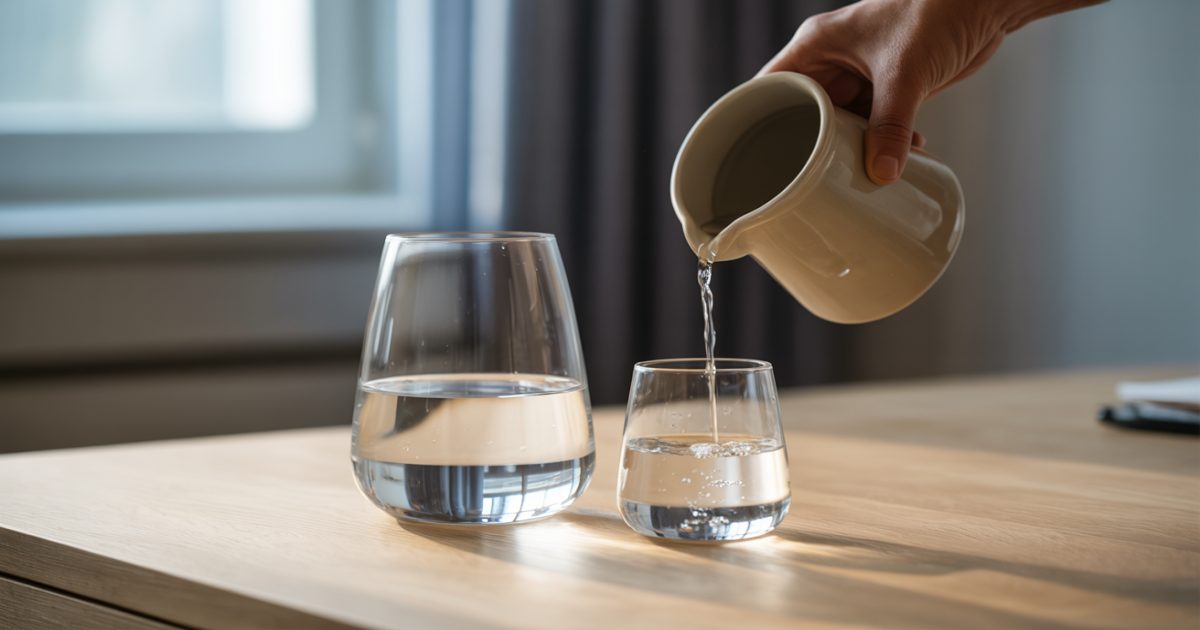
Grams measure weight and millilitres measure volume, so you cannot convert between them without knowing the substance. Water is the exception: it was used to define the metric system, so 1 g of water is exactly 1 mL. Everything else needs its own density.
Grams to millilitres for common substances
| Substance | Density (g/mL) | 100 g | 250 g | 500 g |
|---|---|---|---|---|
| Water | 1.00 | 100 mL | 250 mL | 500 mL |
| Whole milk | 1.03 | 97 mL | 243 mL | 485 mL |
| Olive oil | 0.91 | 110 mL | 275 mL | 549 mL |
| Vegetable oil | 0.92 | 109 mL | 272 mL | 543 mL |
| Honey | 1.42 | 70 mL | 176 mL | 352 mL |
| Maple syrup | 1.33 | 75 mL | 188 mL | 376 mL |
| Ethanol (pure) | 0.79 | 127 mL | 317 mL | 634 mL |
| Granulated sugar | 0.85 | 118 mL | 294 mL | 588 mL |
| Plain flour | 0.53 | 189 mL | 472 mL | 943 mL |
A quick sanity check: if it sinks in water its density is above 1, so the same weight takes up fewer millilitres. If it floats, the volume is larger.
Two things that trip people up
- Assuming 1 g = 1 mL for everything. That holds only for water. For honey the error is 42%, for flour about 27% — enough to ruin a recipe or a measurement.
- Dry goods are loosely packed. Flour and sugar densities assume air-filled scooping, so they can swing by up to 30% with how you fill the cup. Weighing is more reliable than converting.
Common questions
Is 100 grams the same as 100 mL?
Only for water. 100 g of water is 100 mL, but 100 g of honey is about 70 mL, and 100 g of oil is about 110 mL. The difference is the substance's density.
How do I convert grams to mL?
Divide the grams by the density in grams per mL. Water is 1, so grams and millilitres match. Oil is about 0.92, honey about 1.42. So 200 g of oil is 200 divided by 0.92, which is about 217 mL.
How many mL is 500 grams of honey?
About 352 mL. Honey is dense at roughly 1.42 g/mL, so 500 divided by 1.42 gives 352 mL. The same 500 g of water would be exactly 500 mL.