How Much Concrete Do I Need for a Slab? (Bags & Yards)
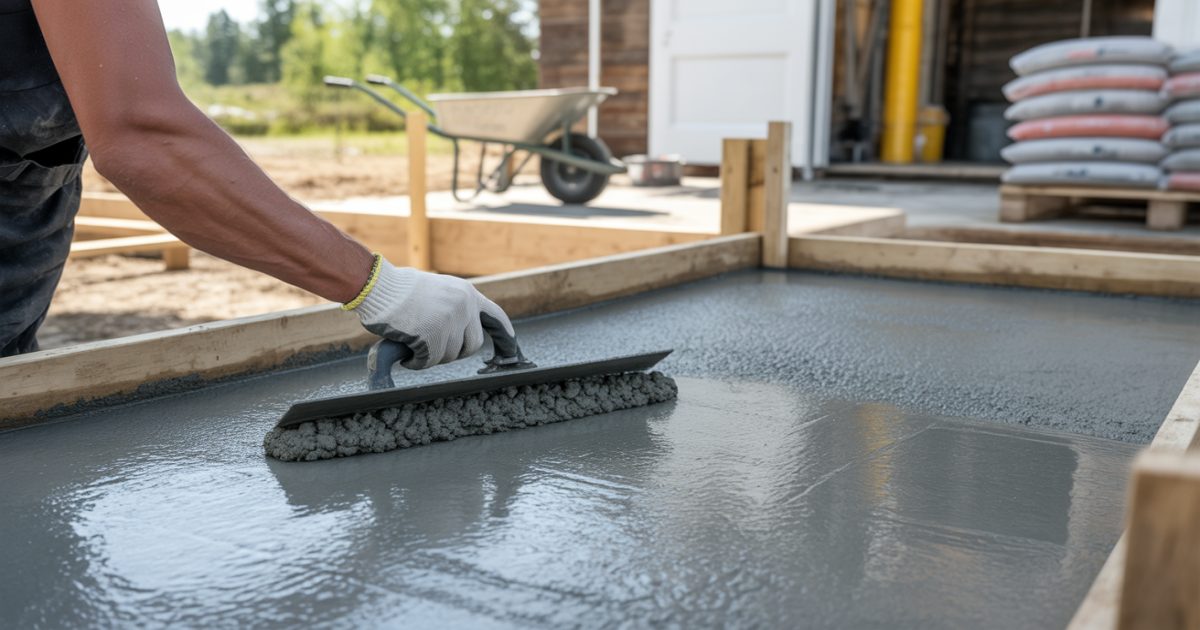
For a rectangular slab, multiply length by width by thickness with every measurement in feet, then divide by 27 to get cubic yards. A 10 × 10 ft slab at 4 inches works out to 33.3 cubic feet, or about 1.23 cubic yards. Ready-mix is ordered by the yard; bagged concrete is counted from each bag's yield.
How do you calculate concrete volume for a slab?
Measure the length, width, and thickness, convert everything to feet, and multiply the three together for cubic feet. Then divide by 27, because one cubic yard holds 27 cubic feet. The only step people miss is the thickness: 4 inches is 0.333 feet, not 4, and skipping that conversion overshoots the volume by a factor of twelve.
- Get the footprint — length × width in feet. A 10 × 10 slab is 100 square feet.
- Convert thickness to feet — divide inches by 12. A 4-inch slab is 4 ÷ 12 = 0.333 ft.
- Multiply for cubic feet — 100 × 0.333 = 33.3 ft³.
- Divide by 27 — 33.3 ÷ 27 = 1.23 cubic yards. That is the raw volume before waste.
- Add about 10% — 1.23 × 1.10 ≈ 1.36 yd³, then round up to what the supplier will deliver.
The same math scales to any depth. A 5-inch slab is just the 4-inch figure times 1.25; a 6-inch slab is the 4-inch figure times 1.5, since 6 inches is half a foot. Footings and thickened edges are separate volumes you add on afterward.
How many cubic yards do I need for common slab sizes?
Most home slabs land between a quarter yard and a couple of yards. The table below gives the raw cubic yards for a 4-inch slab, plus the same figure with 10% waste added. For a 5-inch pour multiply by 1.25; for 6 inches, by 1.5. These are the numbers you hand to a ready-mix supplier.
| Slab size | Area | Cubic yards (4 in) | With 10% waste |
|---|---|---|---|
| 4 × 4 ft | 16 ft² | 0.20 | 0.22 |
| 8 × 8 ft | 64 ft² | 0.79 | 0.87 |
| 10 × 10 ft | 100 ft² | 1.23 | 1.36 |
| 10 × 12 ft | 120 ft² | 1.48 | 1.63 |
| 12 × 12 ft | 144 ft² | 1.78 | 1.96 |
| 20 × 20 ft | 400 ft² | 4.94 | 5.43 |
| 24 × 24 ft | 576 ft² | 7.11 | 7.82 |
How many bags of concrete does a slab take?
Bag counts come straight from each bag's yield. An 80-lb bag of standard concrete mix yields about 0.60 cubic feet, a 60-lb bag about 0.45, and a 40-lb bag about 0.30. Divide your total cubic feet by the bag yield and round up. That 33.3 ft³ slab needs 56 eighty-pound bags before waste, closer to 62 with the 10% cushion.
| Bag size | Yield per bag | Bags per cubic yard |
|---|---|---|
| 80 lb | 0.60 ft³ | ~45 |
| 60 lb | 0.45 ft³ | ~60 |
| 40 lb | 0.30 ft³ | ~90 |
Those yields come from the Quikrete and Sakrete technical data sheets and trace back to ASTM C387, the standard for packaged concrete, so they hold across the major brands. The dry mix in the bag expands with water to the wet volume shown, which is why 80 pounds of powder makes only 0.6 cubic feet of finished concrete.
Should I order ready-mix or use bags?
The dividing line is around one cubic yard. Under about half a yard, roughly 22 or fewer 80-lb bags, mixing your own is reasonable. Over a full yard, order ready-mix and let the truck deliver it wet. The stretch between half a yard and a yard is a judgment call that depends on how many hands you have and how tight the access is.
What mistakes throw off a concrete estimate?
Most bad estimates come from a handful of repeat errors. Each one looks minor on paper but shows up as either a wasted trip to the store or a truck that leaves before the pour is finished.
- Leaving thickness in inches. Multiplying by 4 instead of 0.333 inflates the volume twelvefold. Convert to feet first, every time.
- Skipping the ÷27 step. Cubic feet and cubic yards are not interchangeable; 27 cubic feet fit in a single yard.
- Ordering the exact math. No waste allowance means you run short on an uneven subgrade. Add 10%.
- Ignoring an unlevel base. A subgrade that dips even an inch across the slab quietly adds cubic feet the flat calculation never counted.
Frequently asked questions
How much concrete is in a cubic yard?
One cubic yard equals 27 cubic feet. That is the conversion behind every ready-mix order, since trucks are loaded and billed by the yard rather than by the foot. Divide your total cubic feet by 27 to get yards.
How many 80-lb bags make a yard of concrete?
About 45. An 80-lb bag yields roughly 0.60 cubic feet, and 27 ÷ 0.60 is 45. For 60-lb bags it is about 60 per yard, and for 40-lb bags about 90. Round up, since you cannot buy a partial bag.
How thick should a concrete slab be?
Four inches is standard for patios, walkways, and shed floors. Driveways and slabs that carry vehicle weight usually go to 5 or 6 inches. Local building codes set the minimum, so confirm the required depth before you calculate volume.
How much extra concrete should I order?
Add about 10% to the calculated volume. That covers spillage, an uneven subgrade, and overfilled forms. Running out partway through a pour creates a weak cold joint, so ordering slightly over is far safer than cutting it close.
How much concrete for a 10x10 slab at 4 inches?
About 1.23 cubic yards, or roughly 1.36 yards with 10% waste. In bags that is 56 eighty-pound bags before waste and about 62 with the cushion. The raw math is 100 ft² × 0.333 ft = 33.3 ft³, divided by 27.
Does a thicker slab use proportionally more concrete?
Yes, exactly proportionally. Volume scales straight with thickness, so a 6-inch slab uses 50% more concrete than a 4-inch slab of the same footprint, and a 5-inch slab uses 25% more. Just multiply the 4-inch figure by the depth ratio.
When you have the length, width, and thickness in hand, enter them in the Concrete Slab Volume Calculator to get cubic yards and a bag count in one step, with the 10% waste built in. It handles the inch-to-foot and ÷27 conversions for you, so the only thing left is deciding between the truck and the wheelbarrow.